M. Sc. Alexander Schröder
Julius-Maximilians-Universität
Lehrstuhl für Psychologie I
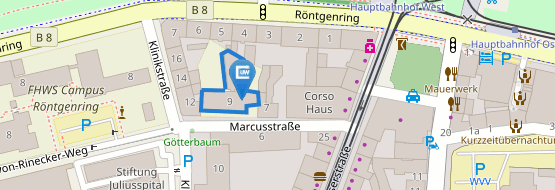
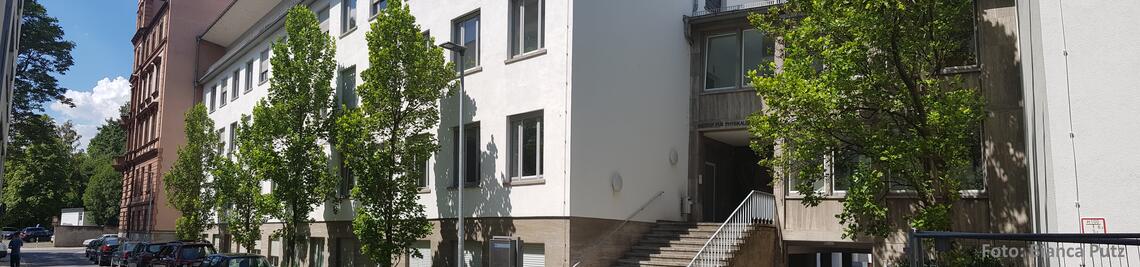
Marcusstr. 9-11
97070 Würzburg
Raum: 007
Telefon: +49 931 31 - 82878
E-Mail: alexander.schroeder@uni-wuerzburg.de
ORCID: 0000-0001-6561-8723
Google Scholar: https://tinyurl.com/alexanderschroeder
seit 04/2026
| Wissenschaftlicher Mitarbeiter am Lehrstuhl für Psychologie I in der Arbeitsgruppe Klinische Psychologie und Psychotherapie von Prof. Dr. Katja Bertsch |
10/2020-02/2026 | Wissenschaftlicher Mitarbeiter an der Klinik für Psychiatrie und Psychotherapie Lübeck, Social Neuroscience Lab, Universität zu Lübeck |
2019 - 2020 | Studentische Hilfskraft an der Klinik für Psychiatrie und Psychotherapie Lübeck, Social Neuroscience Lab, Universität zu Lübeck |
2018 - 2020 | Studium der Psychologie (M.Sc.) an der Universität zu Lübeck |
2015 - 2018 | Studium der Psychologie (B.Sc.) an der Universität zu Lübeck |
- Dynamiken des selbstbezogenen Lernens: Lernen und Revidieren von Selbstkonzepten
- Modelle des sozialen Lernens, Entscheidens und Handelns
- Empathie, Emotionsverarbeitung und -regulation
Schröder, A., Czekalla, N., Mayer, A. V., Zhang, L., Stolz, D. S., Korn, C. W., Diekelmann, S., Luebber, F., Paulus, F. M., Müller-Pinzler, L., & Krach, S. (2025). Initial expectations and confidence affect the formation of novel self-beliefs and their revision. Open Mind, 9, 1576–1596. https://doi.org/10.1162/OPMI.a.36
Mayer, A. V., Schröder, A., Stolz, D. S., Czekalla, N., Paulus, F. M., Mueller-Pinzler, L., Krach, S., & Kube, T. (2025). Self-esteem modulates beneficial causal attributions in the formation of novel self-beliefs. In bioRxiv (p. 2025.10.27.684784). https://doi.org/10.1101/2025.10.27.684784 [Preprint]
Müller-Pinzler, L., Czekalla, N., Mayer, A. V., Schröder, A., Stolz, D. S., Paulus, F. M., & Krach, S. (2022). Neurocomputational mechanisms of affected beliefs. Communications Biology, 5(1), 1–15. https://doi.org/10.1038/s42003-022-04165-3