Fostering inquiry-based learning with embedded generative and retrieval activities
Constructing elaborate and lasting knowledge is a crucial endeavor in inquiry-based teaching. However, empirical research has indicated that students need support when constructing mental representations, which can be applied across different contexts and can result in lasting learning. Generative learning activities and retrieval activities are discussed to contribute to elaborating and consolidating processes, thereby evoking rich mental representations and lasting learning. How these activities should be combined and how they should be embedded into larger instructional units to maximize the construction and consolidation of lasting knowledge are still open questions.
In this research project, we will blend domain-general cognitive science research and subject-specific science education (physics) to shed light on the effectiveness of generative and retrieval activities in the context of inquiry-based teaching. The first aim of this project is to investigate whether combining different generative activities (explaining to fictitious others and drawing) enhances the construction of rich mental representations during inquiry learning. The second aim is to investigate whether consolidation processes during activities can be further improved by integrating principles of lasting learning. Therefore, we investigate effects of spacing and the effects of supplementing generative activities by retrieval practice on learning. We will conduct three classroom experiments (Grade 7 and 8 physics students) with a pre- posttest design, including an immediate and an eight-week delayed posttest to answer these research questions. In addition to students’ learning outcomes, we will analyze their explanations and drawings to portray the underlying learning processes.
Keywords: learning by explaining; drawing; retrieval practice; inquiry-based learning
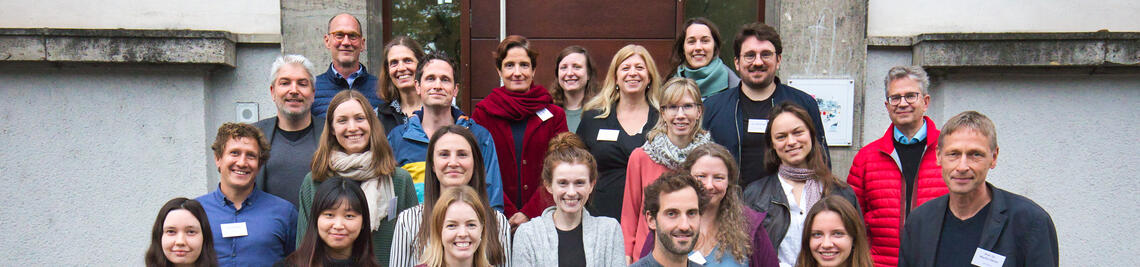
Click here to see our team.
Preprints/Submitted
Russ, H., Endres, T., Sibley, L., Flegr, S., Kuhn, J., Hoogerheide, V., Scheiter, K., & Lachner, A. (2025). Happy or redundant? Retrieval practice enhances lasting learning in non-interactive teaching for low-quality explanations. PsyArXiv Preprint. https://doi.org/10.31234/osf.io/uh6v3_v2
2025
Lachner, A.*, Russ, H.*, Hübner, N., Sibley, L., & Scheiter, K. (2025). When does learning by non-interactive teaching work? A large-scale analysis of learner characteristics in a classroom setting. Educational Psychology Review, 37, Article 88. https://doi.org/10.1007/s10648-025-10060-0 (open access)
Russ, H. (2025).Toward Lasting Learning? Enhancing Non-Interactive Teaching in Inquiry-Based Authentic Science Lessons [Doctoral dissertation, University of Tübingen]. https://doi.org/10.15496/publikation-110630
Russ, H., Sibley, L., Flegr, S., Kuhn, J., Hoogerheide, V., Scheiter, K., & Lachner, A. (2026). Combining non-interactive teaching and drawing fosters conceptual knowledge but not monitoring accuracy from guided inquiry in science learning. Journal of Educational Psychology, 118(3), 345–367. https://doi.org/10.1037/edu0000971 (open access)
Russ, H., Sibley, L., Flegr, S., Kuhn, J., Hoogerheide, V., Scheiter, K., & Lachner, A. (2025). Does distributing non-interactive teaching contribute to learning? Students' academic self-concept and work ethic matter. Learning and Individual Differences, 120, 102687. https://doi.org/10.1016/j.lindif.2025.102687 (open access)
Sibley, L., Fabian, A., Plicht, C., Pagano, L., Erhard, N., Wellert, L., Bohl, T., & Lachner, A. (2025). Adaptive teaching with technology enhances lasting learning. Learning and Instruction, 99, 102141. https://doi.org/10.1016/j.learninstruc.2025.102141 (open access)
2024
Sibley, L., Russ, H., Ahmad, G., Baumgärtner, B., Bräutigam, D., Brümmer, S., Bussmann, H., Erb, N., Evans, L., Fischer, S., Gradl, L., Guddemi, R., Hauptmann, K.-B., Hieke, J., Hilsdorf, S., Högerle, F., Hoppe-Brixner, B., Jeong, W., Karl, S., … Lachner, A. (2024). Does technology-based non-interactive teaching enhance students’ learning in the classroom? Computers and Education Open, 7, 100233. https://doi.org/10.1016/j.caeo.2024.100233 (open access)
2022
Ebersbach, M., Lachner, A., Scheiter, K., & Richter, T. (2022). Using spacing to promote lasting learning in educational contexts: Promises and challenges. Zeitschrift für Entwicklungspsychologie und Pädagogische Psychologie [German Journal of Developmental and Educational Psychology], 54(4), 151–163. https://doi.org/10.1026/0049-8637/a000259 (open access)
Jacob, L., Lachner, A., & Scheiter, K. (2022). Do school students’ academic self-concept and prior knowledge constrain the effectiveness of generating technology-mediated explanations? Computers & Education, 182, 104469. https://doi.org/10.1016/j.compedu.2022.104469
Omarchevska, Y., Lachner, A., Richter, J., & Scheiter, K. (2022). Do video modeling and metacognitive prompts improve self-regulated scientific inquiry? Educational Psychology Review, 34, 1025–1061. https://doi.org/10.1007/s10648-021-09652-3
Richter, T., Berger, R., Ebersbach, M., Eitel, A., Endres, T., Borromeo Ferri, R., Hänze, M., Lachner, A., Leutner, D., Lipowsky, F., Nemeth, L., Renkl, A., Roelle, J., Rummer R., Scheiter, K., Schweppe J., von Aufschnaiter, C., & Vorholzer, A. (2022). How to promote lasting learning in schools: Theoretical approaches and an agenda for research. Zeitschrift für Entwicklungspsychologie und Pädagogische Psychologie [German Journal of Developmental Psychology and Educational Psychology], 54(4), 135–141. https://doi.org/10.1026/0049-8637/a000258 (open access)
Roelle, J., Schweppe J., Endres, T., Lachner, A., von Aufschnaiter, C., Renkl, A., Eitel, A., Leutner D., Rummer R., Scheiter, K., & Vorholzer, A. (2022). Combining retrieval practice and generative learning in educational contexts: Promises and challenges. Zeitschrift für Entwicklungspsychologie und Pädagogische Psychologie [German Journal of Developmental and Educational Psychology], 54(4), 142–150. https://doi.org/10.1026/0049-8637/a000261 (open access)
Go to main page